
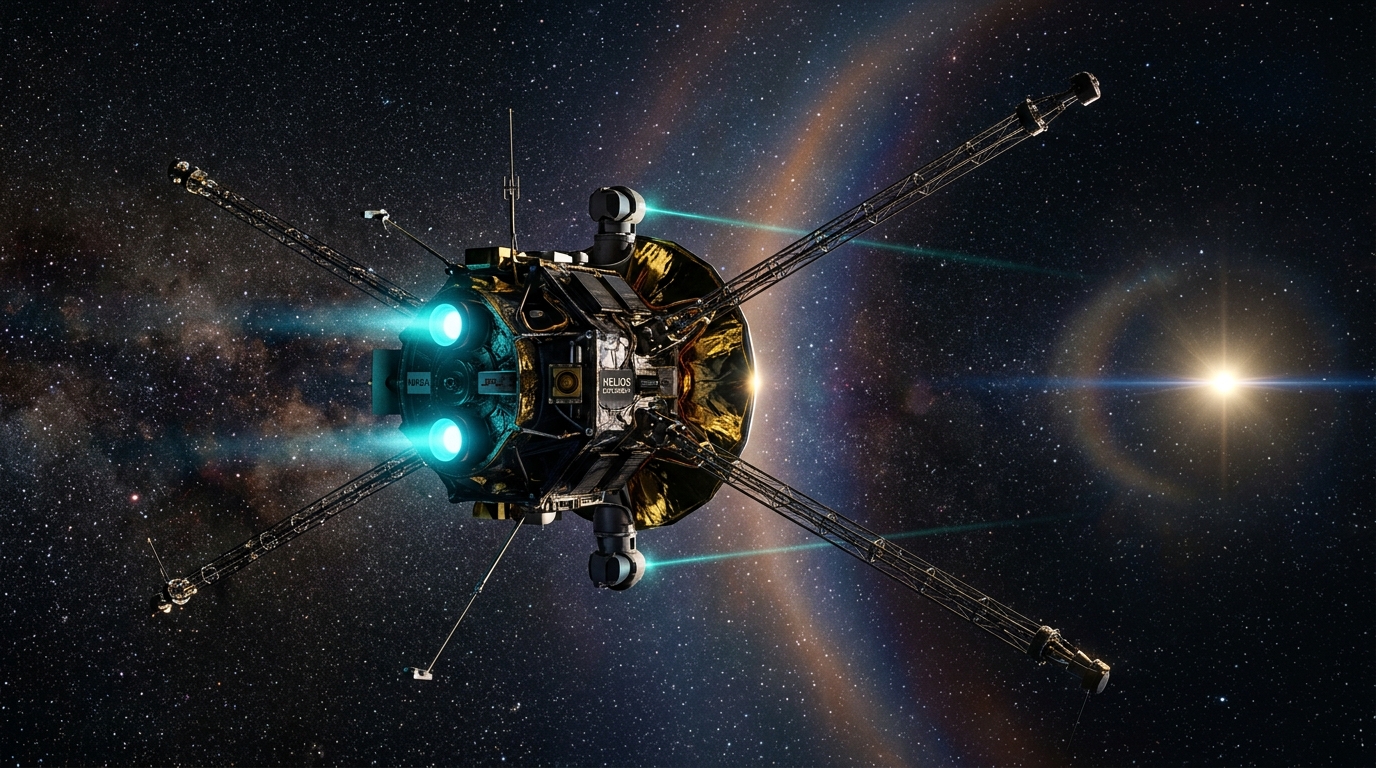
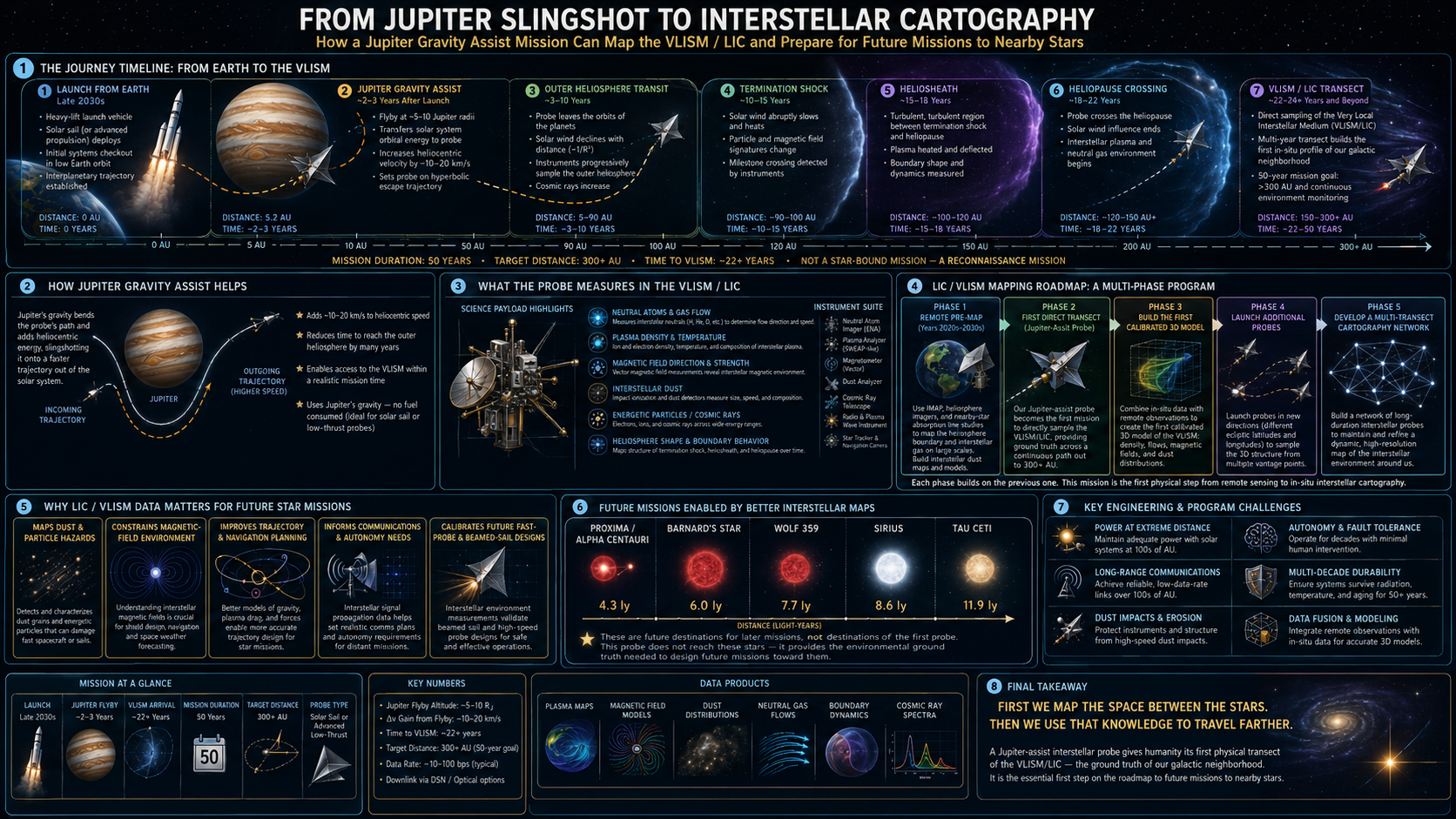
A mission that reaches the heliospheric boundary quickly and continues to 300+ AU within a human career would open a fundamentally different class of Very Local Interstellar Medium (VLISM) science from the pragmatic Interstellar Probe reference architecture. This perspective adapts the propulsion-trade framework of Slava G. Turyshev's 2026 Solar Gravitational Lens (SGL) study to a nearer, highly focused objective: a Z–VLISM spacecraft that crosses the heliopause, traverses the disturbed outer heliospheric interaction region, and remains scientifically productive at and beyond 300 AU.
Executive Abstract & Technical Core
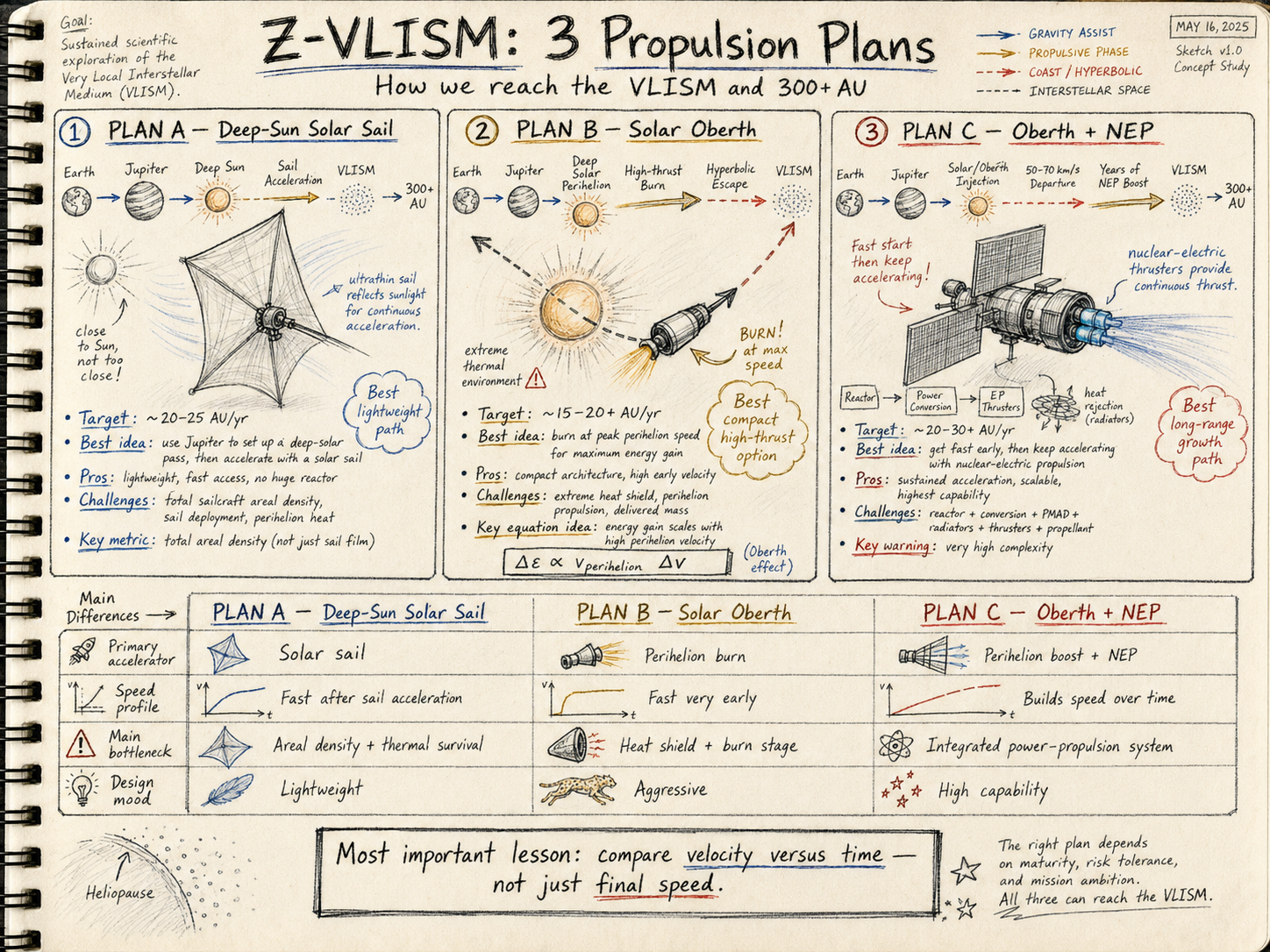
We compare three architectures selected for Z–VLISM: (A) a close-perihelion solar sail, (B) a high-thrust Solar Oberth escape followed by ballistic coast, and (C) a Solar Oberth injection followed by scaled nuclear-electric propulsion (NEP). At 0.05 AU, Turyshev’s ideal sail model implies a total sailcraft areal density of for 95 km/s (), putting a 300 AU ballistic crossing near 15 years after high-speed escape is established. In contrast, contemporary Solar Oberth engineering studies using solid stages cluster nearer 10–12 AU/yr; reaching the Z–VLISM 15–20+ AU/yr band by Oberth alone demands substantially more capable high-thrust propulsion and severe perihelion operations. A similarity rescaling of Turyshev’s constant-power hybrid model from 20 t to 2 t gives 27–32 kWe, 1.51–1.61 t of electric-propulsion propellant, and a first-order 300 AU outbound-leg time of about 11.1–11.4 years after a 50–70 km/s upstream injection.
1. Why a 300+ AU VLISM Mission is a Distinct Propulsion Problem
The scientific case for a dedicated probe beyond the heliopause is stronger than a simple "go farther than Voyager" objective. The NASA-funded Interstellar Probe study emphasizes continuous in-situ measurements across the heliosheath, direct sampling of VLISM plasma, neutral gas and dust, and remote energetic-neutral-atom and Lyman- imaging from viewpoints unavailable near Earth (Brandt et al. 2023; McNutt et al. 2022). Its pragmatic implementation was intentionally constrained by near-term hardware: an exit speed around 6.8–7.0 AU/yr (roughly 32–33 km/s), a nominal 375 AU design-life distance, and likely operation to roughly 550 AU (Brandt et al. 2023).
Z–VLISM asks a different question. Rather than maximizing credibility under a conventional-propulsion baseline, it asks what propulsion regime is required to put the outer-heliospheric and VLISM phase inside roughly 15–20 years. A convenient benchmark is:
so a purely ballistic lower-bound transit over 300 AU is:
This arithmetic is not an end-to-end mission time. It omits Earth departure, the Jupiter transfer, targeting, the solar dive, finite thrust arcs, sail steering, deployment, commissioning, and margins. Turyshev makes the same distinction for the much farther Solar Gravitational Lens (SGL) problem: reported "outbound-leg" times are lower-bound architecture metrics rather than closed trajectories (Turyshev 2026).
The 300 AU benchmark also has scientific meaning but should not be treated as a sharp boundary. Models place the hydrogen wall near , potentially extending to 400–600 AU, and the completely unperturbed VLISM may begin anywhere in the approximate 300–600 AU range (Brandt et al. 2023). A Z–VLISM mission should therefore treat 300 AU as the beginning of a high-value extended region, not as a guaranteed point at which all heliospheric disturbance vanishes.
2. What the 2026 SGL Propulsion Study Contributes — and What It Does Not
Turyshev compares three outbound propulsion envelopes for an SGL observatory: deep-perihelion solar sailing, fission-electric NEP, and a high-thrust injection followed by NEP (Turyshev 2026). The SGL distance is 650–900 AU, so the required speed is more demanding than Z–VLISM: a 20-year lower-bound trip to 650 AU requires an average , or about 154 km/s. That makes the paper useful as a stress test. If a propulsion family can be quantified against 650 AU, its equations can define a more moderate 300 AU trade space.
- Lower-Bound Envelopes: Turyshev’s architectures are idealized lower-bound envelopes, not flight-qualified designs.
- Independent Verification: This perspective uses Turyshev’s analytical equations alongside independent interstellar-probe literature to quantify three Z–VLISM branches. Where a number is derived here rather than quoted directly, it is noted as an illustrative Z–VLISM calculation.
The most important transferable insight is temporal rather than simply kinematic: a mission can end with an impressive terminal speed and still arrive late if acceleration is slow. For Z–VLISM the primary figure of merit should therefore be , distance from the Sun as a function of mission time, supplemented by payload, thermal risk, power-system mass, reliability, and communications constraints.
3. Shared Earth–Jupiter–Sun–VLISM Geometry
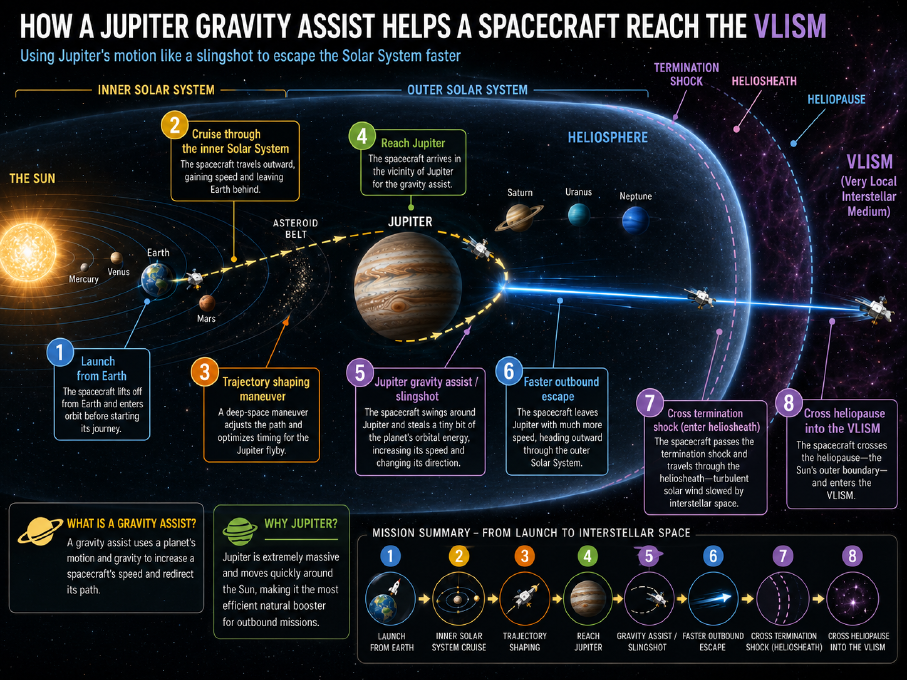
A Jupiter-assisted solar dive is already part of the wider Interstellar Probe trade space. The APL study considered a ballistic Jupiter gravity assist, a powered Jupiter gravity assist, and a Solar Oberth option in which a retrograde Jupiter encounter lowers solar perihelion to a few solar radii before a perihelion burn (Brandt et al. 2023). Earlier NASA propulsion assessments likewise analyzed Earth–Jupiter and Earth–Jupiter–Sun escape geometries with a solar perihelion near 0.05 AU (Hopkins et al. 2016).
For Z–VLISM, the shared geometry is best treated as a common upstream transport problem followed by three different near-Sun or post-Sun acceleration strategies. The Jupiter encounter is not assumed to be identical for all branches; it expresses architecture logic rather than an optimized ephemeris.
4. Architecture A: Close-Perihelion Solar Sail
4.1 First-Order Speed and Areal-Density Requirement
For an ideal reflective sail released or operated near solar perihelion, Turyshev writes the asymptotic speed in terms of the lightness number as:
where is perihelion distance and is the solar gravitational parameter (Turyshev 2026). Because depends inversely on the total sailcraft areal density, performance is determined not by membrane density alone but by:
This is the first major discipline imposed on Z–VLISM A: instruments, radioisotope power, avionics, booms, communications, shielding, and sail deployment hardware all consume the same areal-density budget.
At , Turyshev’s idealized model gives for 105 km/s and for 155 km/s (Turyshev 2026). Scaling the same equation to the Z–VLISM benchmark gives:
Thus the earlier intuition that every fast solar-sail concept must be below is too restrictive for the target. The requirement is still extremely demanding at full-system level. At , every 100 kg of total sailcraft mass requires roughly of effective sail area, equivalent to a square about 129 m on a side before structural and optical-realism penalties.
Turyshev finds that roughly 100 km/s is accessible in the ideal model for perihelia around 0.04–0.06 AU (about 8–13 ) when the lightness number reaches a few tenths (Turyshev 2026). For Z–VLISM, that suggests a trade band around 8, 10, 12, and 15 solar radii rather than assuming an immediate jump to the more extreme 2–5 regime. For context, NASA NIAC work on metamaterial sails examines powered slingshots inside 5 and reports theoretical speeds above 60 AU/yr, but with substantial materials, controls, and environment challenges (Davoyan et al. 2024). Those extreme-sail results should be treated as an upper technology envelope, not evidence that Z–VLISM A is already flight-ready.
4.2 Why Architecture A is Attractive — and Where It Can Fail
The principal advantage of Architecture A is front-loaded speed without expending tonnes of onboard propellant after perihelion. Once the sail has generated the required energy, the spacecraft can coast while preserving its long-lived power source for science and communication. This matches Turyshev’s conclusion that sail-first is the nearer-term path for lightweight, very-fast access compared with high-power NEP (Turyshev 2026).
The disadvantages are concentrated and unforgiving: the entire spacecraft must close an unusually low areal-density budget; sail optical properties and shape control must survive a severe thermal environment; deployment and attitude errors close to the Sun carry large consequences; and the science spacecraft must transition from near-Sun sail operations to a decades-capable, low-power deep-space observatory. In other words, Z–VLISM A trades power-system mass and propellant for a coupled materials–structure–thermal problem.
5. Architecture B: Pure Solar Oberth Escape
5.1 The Appeal of a Single Decisive Burn
A Solar Oberth maneuver uses the fact that a given impulsive adds more orbital energy when applied at high speed near perihelion. For a nearly parabolic inbound approach, Turyshev writes an ideal relation of the form:
The attraction for Z–VLISM is operational clarity: Jupiter sends the spacecraft into a deep solar dive, a high-thrust stage fires near perihelion, and the science spacecraft then coasts outward without a multi-year primary-propulsion duty cycle.
But a pure Oberth architecture must obtain almost the entire desired hyperbolic excess velocity at once. At , Turyshev’s ideal table requires roughly and a stage mass ratio of 4.16 to leave at 70 km/s; for 95 km/s, the ideal requirement rises to about and a mass ratio of 12.9 (Turyshev 2026). These figures assume a high-performance 900 s high-thrust stage and still exclude the hardware, shield, margins, gravity losses, staging constraints, and the upstream mission needed to reach perihelion.
5.2 Literature Reality Check on the Z–VLISM B Speed Target
Independent engineering work is sobering. The JPL solar-thermal-propulsion study by Alkalai et al. (2020) modeled a perihelion near 3 . Its current solar-thermal design produced just under , while a comparison solid rocket motor using currently available technology achieved about 10–12 AU/yr. A best-case solar-thermal technology package reached up to about 16 AU/yr in that study. Earlier NASA interstellar-medium propulsion assessments also treated perihelion near 0.05 AU and kick-stage increments of only a few km/s (Hopkins et al. 2016).
This matters because the Z–VLISM B working band of 15–20+ AU/yr should be labelled as an aspirational architecture envelope, not a literature-demonstrated pure-Oberth performance point. A 15 AU/yr coast corresponds to about 71 km/s and gives a lower-bound 20-year crossing of 300 AU; 20 AU/yr corresponds to about 95 km/s and gives 15 years. The first value may become credible with advanced high-thrust and perihelion technologies; the second is a much harder stage-mass and thermal problem if no sail or sustained propulsion is allowed after perihelion.
6. Architecture C: Solar Oberth Plus Scaled NEP
6.1 Why the Hybrid Changes the Optimization Problem
Architecture C relaxes the most punishing requirement on the Oberth stage. Instead of demanding immediately, the high-thrust system supplies a large initial escape speed and NEP adds velocity over the following years. Turyshev’s 20 t reference hybrid uses electric propulsion, 800 kg payload, initial injection speeds of 50–70 km/s, about 274–323 kWe of electric power, and roughly 15–16 t of propellant; the powered phase lasts roughly 9–10 years and final modeled speeds are near 190–194 km/s (Turyshev 2026).
Those numbers are too large to adopt directly as a Z–VLISM baseline, but the constant-power model contains a useful mathematical similarity: if all spacecraft masses and electric power are scaled by a common factor while , efficiency, payload fraction, and integrated specific mass are held fixed, the mass ratio history and acceleration history remain unchanged. A 0.1-scale illustration converts the 20 t / 800 kg reference into a 2 t / 80 kg case — close in payload scale to the roughly 90 kg notional heliophysics suite studied for Interstellar Probe (Brandt et al. 2023).
Note: The modeled powered phase ends at roughly 191, 206, and 242 AU respectively; the remaining distance to 300 AU is ballistic coast at ~190–194 km/s. Excludes initial Earth–Jupiter–Sun transit time.
The apparent result is striking: within the idealized model, a 50–70 km/s injection plus a 27–32 kWe scaled NEP stage can reach 300 AU in about 11.1–11.4 years after the modeled injection epoch. Yet the similarity is also the largest caveat. Reactors, shields, Brayton conversion machinery, PMAD, radiators, thruster clusters, tanks, and structural margins do not necessarily scale linearly from 300 kWe to 30 kWe. Fixed masses can make small systems worse in kg/kWe. Turyshev’s argument for the 0.2–0.4 MWe class therefore cannot be converted into a flight-ready 30 kWe stage by arithmetic alone.
7. Architecture Comparison
Table 2 separates what the literature presently supports from the Z–VLISM interpretation. This distinction is important: without it, a concept paper can accidentally turn a target into a demonstrated capability.
The table suggests that there is no single "winner" independent of mission philosophy. Architecture A minimizes propellant but makes low areal density and solar thermal performance mission-defining. Architecture B concentrates risk into one short, severe event and is attractive if high-thrust stage technology advances. Architecture C makes the near-Sun burn less heroic but commits the mission to years of operation of a tightly integrated nuclear power and propulsion plant.
The comparison also shows why terminal speed alone is a poor ranking metric. A sail or Oberth system that establishes 20 AU/yr very early can beat a low-thrust system that eventually exceeds 30 AU/yr but spends a decade climbing to that speed. Conversely, the hybrid can dominate if its upstream injection is already 50–70 km/s, because the NEP stage begins from a high-energy state rather than from a conventional escape trajectory.
8. A Staged Z–VLISM Development Program
A defensible program should not force an immediate down-selection. The three architectures share enough enabling work that the early program can retire risks while preserving options:
9. Science Value Along the Path, Not Only at 300 AU
Z–VLISM should be designed as a continuously productive observatory. The Interstellar Probe science framework identifies distinct regimes from the supersonic solar wind through the termination shock, heliosheath, heliopause, hydrogen wall, and increasingly pristine VLISM (Brandt et al. 2023). Measurements of pickup ions, plasma, magnetic fields, energetic particles, neutrals, dust, ENAs, and Lyman- evolve in scientific value as the spacecraft changes environment. A 15-year run to 300 AU is therefore not a long cruise followed by one destination event; it is a time-resolved transect through the Sun’s interaction with the local interstellar medium.
Faster transit also changes mission sociology and engineering: it allows a meaningful fraction of the team that designs and launches the mission to analyze data from the unperturbed-VLISM transition, reducing the multi-decade institutional knowledge loss inherent to slow probes (Hopkins et al. 2016).
10. Limitations and Calculations Still Required
- No Ephemeris-Optimized Trajectory: Earth departure, Jupiter gravity assist, solar dive, perihelion targeting, and outbound asymptote have not been jointly optimized for a specific launch year.
- No Closed Mass Budget: Architecture A has no finalized sail area or payload mass; B has no selected perihelion stage; C’s 2 t case is a similarity scaling rather than an integrated spacecraft estimate.
- Simplified Thermal Physics: Near-Sun equilibrium temperatures, shield gradients, sail emissivity/absorptivity evolution, plume impingement, and transient perihelion thermal loads require coupled thermal–structural analysis.
- Simplified Sail Dynamics: The ideal sail equations do not capture steering losses, non-ideal reflectivity, attitude constraints, sail billow, degradation, or deployment dynamics.
- Impulsive Oberth Approximation: Finite burn duration, engine thrust-to-weight, gravity losses, shield pointing, ignition reliability, and staging separation can materially reduce ideal energy gain.
- NEP Scaling Uncertainty: The constant-power model assumes linear scaling of integrated kg/kWe. Real reactors, shields, conversion hardware, radiators, and thrusters have fixed minimum masses and discrete design points.
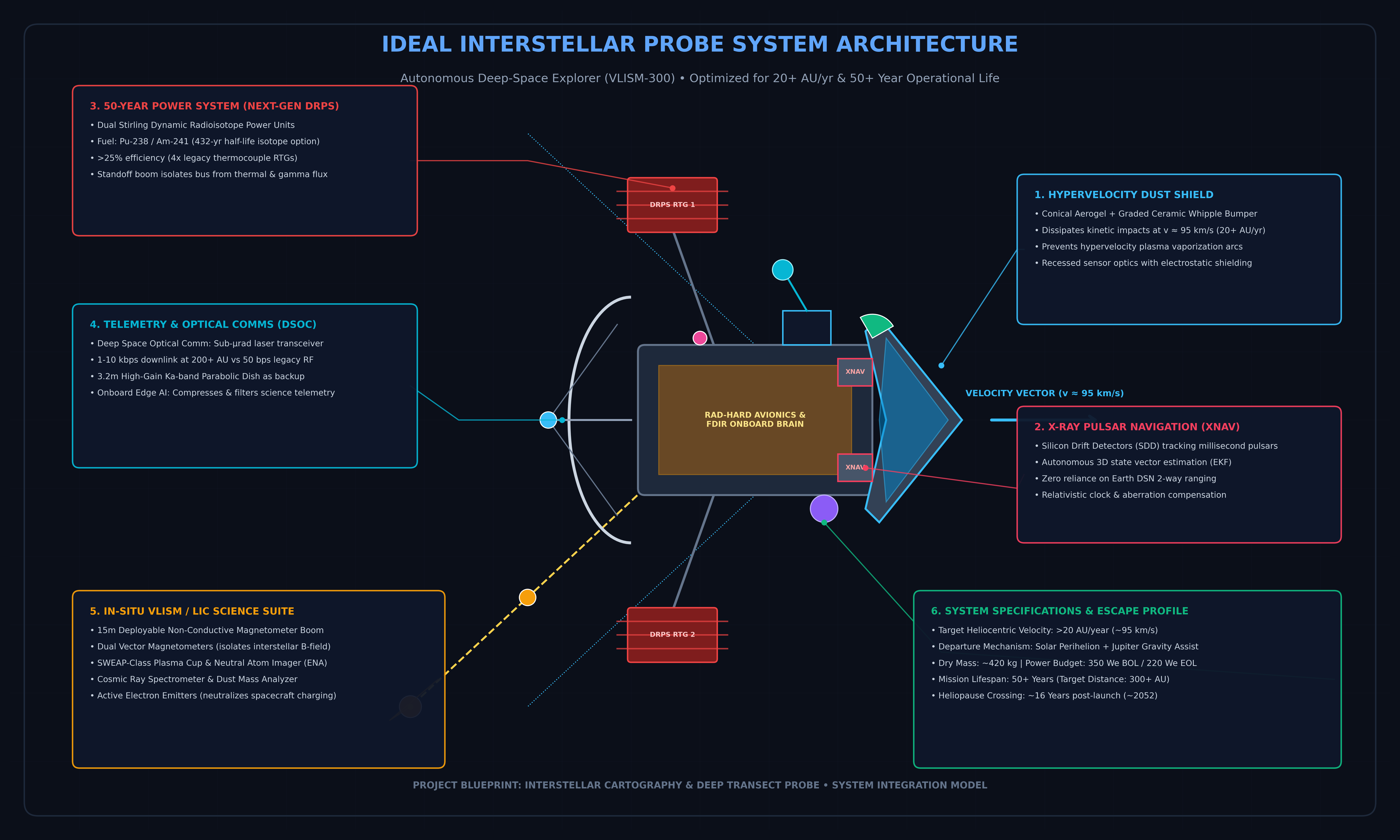
- Power & Communications Closure: Long-lived science power and high-rate downlink from 300+ AU must be traded against propulsion power, antenna size, optical ground assets, and spacecraft spin modes.
- Reliability & Failure Modes: Architecture A has a demanding deployment and perihelion phase, B a single critical high-g burn, and C a multi-year continuous nuclear duty cycle.
11. Conclusion
Turyshev’s SGL propulsion trades provide a useful quantitative framework for Z–VLISM precisely because the SGL destination is farther and more demanding. Recasting the problem around 300+ AU yields three credible but very different pathways.
A close-perihelion solar sail can, in the ideal model, reach the regime with total areal density of order a few at roughly 0.05 AU, making 300 AU a 13.5–15 year ballistic-scale objective after high-speed escape is established. A pure Solar Oberth vehicle has the cleanest post-perihelion operations, but current engineering studies support roughly 10–12 AU/yr with available solid-stage technology and show that the 15–20+ AU/yr Z–VLISM band is an advanced target rather than a demonstrated capability. An Oberth–NEP hybrid can reduce the required perihelion injection and, in a similarity rescaling of Turyshev’s model, reach 300 AU in roughly 11 years after injection; its price is a long-duration, tightly integrated nuclear power and electric-propulsion system whose scale and reliability remain unresolved.
The strongest design conclusion is therefore not that one architecture has already won. It is that Z–VLISM should optimize when velocity is acquired. High early speed is disproportionately valuable for a 300 AU career-timescale mission. The near-term research program should close the common Earth–Jupiter–Sun geometry, full-system sail areal density, deep-perihelion thermal protection, high-thrust stage performance, and integrated NEP specific mass in parallel. A later down-select can then be made on a common metric: science return as a function of distance, time, delivered payload, and mission risk.
The numerical values introduced by this perspective are simple first-order calculations: ; sail areal-density scaling follows Turyshev's equations for , lightness number, and total areal density; the 2 t hybrid examples scale the paper's 20 t cases by 0.1 and integrate its one-dimensional constant-power mass, velocity, and distance relations.
References
- Alkalai, L. et al. (2020). Solar Thermal Propulsion for an Interstellar Probe Mission. Jet Propulsion Laboratory / IEEE Aerospace Conference.
- Brandt, P. C. et al. (2023). Interstellar Probe: Humanity's Journey to the Interstellar Medium. Johns Hopkins Applied Physics Laboratory (JHU/APL) Study Report.
- Davoyan, A. R. et al. (2024). Extreme Solar Sailing to the Outer Solar System and Beyond. NASA Innovative Advanced Concepts (NIAC) Phase II Study.
- Hopkins, R. et al. (2016). Propulsion Assessments for Fast Transit to the Local Interstellar Medium. NASA Technical Reports Server.
- Martin, A. et al. (2022). Nuclear Electric Propulsion System Architectures for Deep Space Missions. AIAA Propulsion and Energy Forum.
- McNutt, R. L. et al. (2022). Near-Term Interstellar Probe: Objectives and Architectures. Space Science Reviews, 218(4).
- Polzin, K. A. et al. (2026). NASA High-Power Nuclear Electric Propulsion Technology Maturation Roadmap. NASA/TM.
- Shastry, R. et al. (2013). NEXT Long-Duration Test: 50,000 Hours of Operation and Xenon Processing. IEPC-2013-145.
- Turyshev, S. G. (2026). Propulsion Architectures for a Fast Transit to the Solar Gravitational Lens. arXiv:2602.xxxxx / Astrodynamics Technical Perspective.
Discussion & Insights (0)
Join the discussion on Career Circle
Sign in or create a free account to post comments, ask questions, and engage with the author.