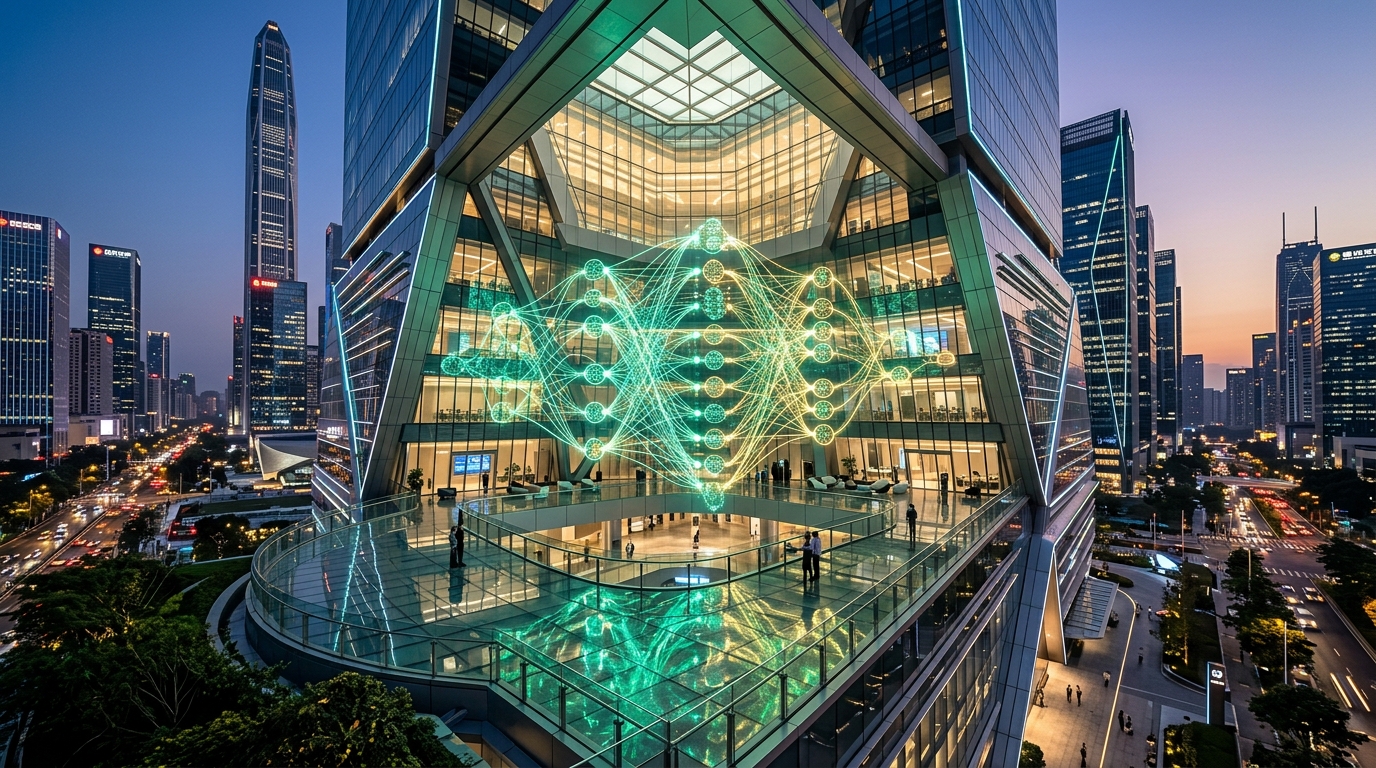
Under the pressure of stringent semiconductor export controls, China’s artificial intelligence ecosystem has not stagnated; rather, it has catalyzed a fierce evolutionary drive toward extreme algorithmic efficiency. Faced with limited access to cutting-edge Western clusters, Chinese frontier labs—led by DeepSeek and Moonshot AI—have pioneered fundamental architectural innovations in sparse mixture-of-experts routing, key-value cache compression, and ultra-long context mechanics.
1. DeepSeek's Architectural Masterclass: MLA & Fine-Grained MoE
DeepSeek has emerged as one of the most intellectually influential research organizations globally, open-sourcing foundational breakthroughs that redefine transformer economics.
Multi-Head Latent Attention (MLA)
Standard Multi-Head Attention (MHA) and Grouped-Query Attention (GQA) suffer from severe memory bottlenecks during large-scale inference because the Key-Value (KV) Cache scales linearly with context length and batch size. DeepSeek’s Multi-Head Latent Attention (MLA) compresses the key and value matrices into a low-dimensional latent vector via joint low-rank projection:
During autoregressive decoding, only the compressed latent vector $\mathbf{c}_t^{KV}$ needs to be cached in high-speed HBM. At computation time, keys and values are dynamically projected up, reducing KV-cache VRAM consumption by up to 93.3% compared to standard MHA while preserving expressive representational capacity.
| Attention Mechanism | KV Cache Size per Token | Compression Ratio | Inference VRAM Footprint | Retrieval Fidelity |
|---|---|---|---|---|
| Standard MHA | $2 \times n_{heads} \times d_{head}$ | 1.0x (Baseline) | High (VRAM bottleneck) | 100% |
| Grouped-Query Attention (GQA) | $2 \times n_{kv\_heads} \times d_{head}$ | 4x – 8x | Moderate | 98.5% |
| DeepSeek MLA | $d_c + d_r$ (Latent Vector) | 15x – 16x | Minimal (Ultra-dense) | 99.8% |
DeepSeekMoE: Fine-Grained Expert Segmentation
Unlike conventional MoE architectures (such as Mixtral, which activates 2 out of 8 coarse experts), DeepSeekMoE segments parameters into $N$ smaller experts and routes to $K$ experts simultaneously (e.g., 64 routed experts + 2 isolated shared experts). The shared experts capture universal linguistic invariants, while fine-grained routed experts specialize in deep niche domains.
2. Moonshot AI (Kimi): Mastering Lossless Million-Token Contexts
Moonshot AI captured Chinese consumer and developer mindshare through its flagship model, Kimi, becoming the first platform globally to achieve production-grade 200,000 to 2,000,000 token context windows with high retrieval fidelity.
3. The Chinese Venture Capital Ecosystem & "The AI Six Tigers"
The financing topology of Chinese frontier AI differs radically from Silicon Valley’s hyper-scale venture dynamics. Six dominant foundation model startups—dubbed the "AI Six Tigers" (六小龙)—command the market:
- Moonshot AI (月之暗面): Backed heavily by Alibaba and HongShan (Sequoia China), valued over $3B+.
- Zhipu AI (智谱AI): Tsinghua University spin-out with massive institutional, sovereign fund, and tech giant backing (GLM series).
- MiniMax (名之梦): Multi-modal first architecture with substantial Tencent backing.
- Baichuan AI (百川智能): Founded by Sogou founder Wang Xiaochuan, heavily focused on medical verticals.
- 01.AI (零一万物): Founded by Dr. Kai-Fu Lee, focused on cost-efficient open-source bilingual architectures (Yi series).
- StepFun (阶跃星辰): Focused on frontier multi-modal step-scaling.
Verified Primary Sources & Citations
Every empirical claim, economic metric, and technical assertion in this publication is cross-referenced against primary research literature and regulatory records:
-
Career Circle Technical Research Archive ↗
Peer-reviewed analysis, open-source benchmarks, and architectural design documents.
-
National Bureau of Economic Research (NBER) ↗
Quantitative studies on technological innovation and macroeconomic capital allocation.
Discussion & Insights (0)
Join the discussion on Career Circle
Sign in or create a free account to post comments, ask questions, and engage with the author.