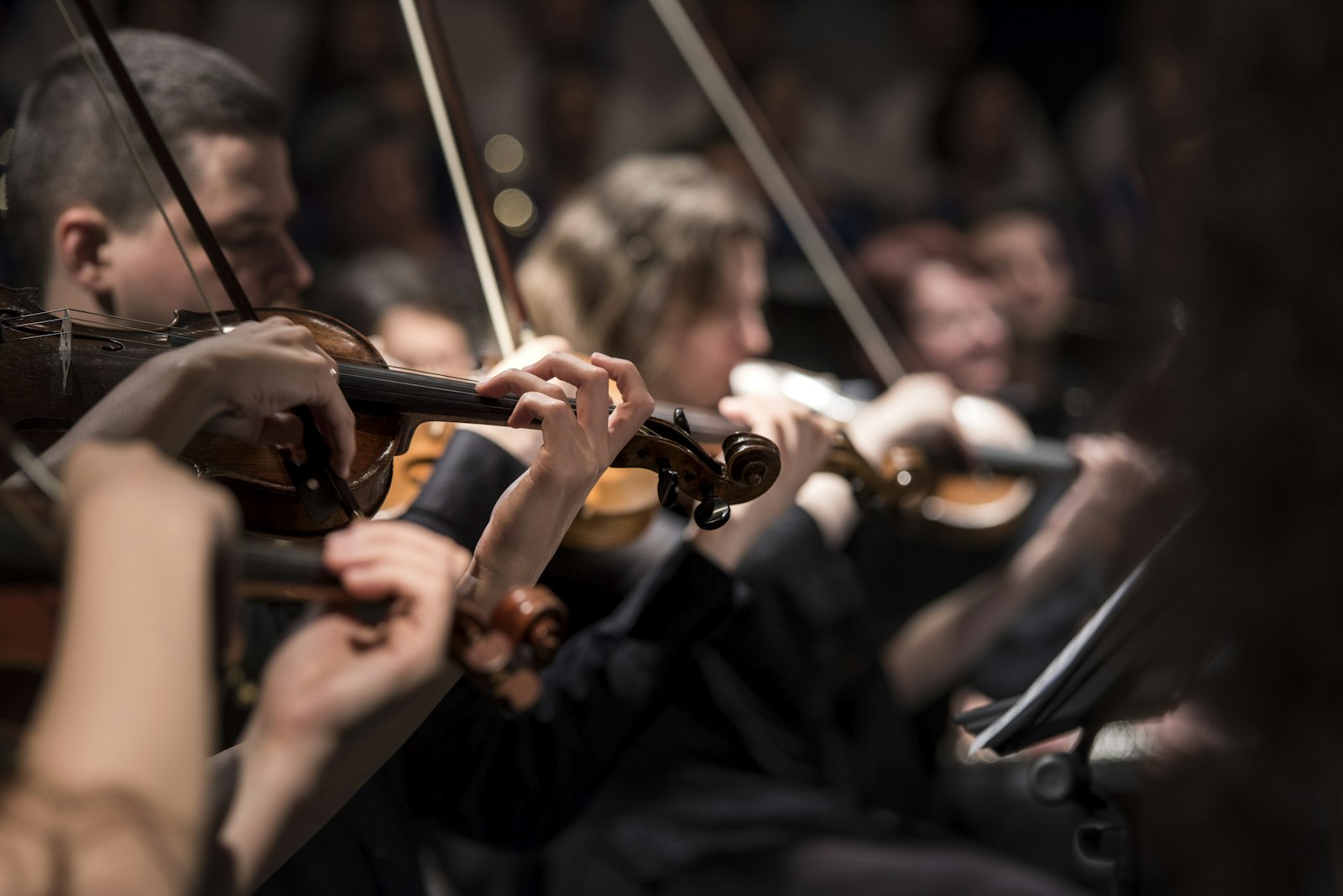
A full symphony orchestra is the most complex analog acoustic synthesizer ever engineered. Spanning over eighty musicians and dozens of distinct acoustic families—strings, woodwinds, brass, and percussion—the orchestra operates at the nexus of wave physics, structural orchestration, and human psychoacoustics.
1. Spectral Centroid and Orchestral Balance
In orchestration theory, timbre is defined by its spectral centroid—the center of gravity of the frequency spectrum:
When Gustav Mahler scores a climactic tutti in his Second Symphony ("Resurrection"), he avoids acoustic masking by assigning lower woodwinds (bassoons, bass clarinets) to reinforce the cellos and tubas while reserving open flutes and high violins for the harmonic overtone ceiling above (4\text{ kHz}). This separation prevents mid-frequency phase cancellation and ensures vocal clarity through dense symphonic textures.
Acoustic Masking in Symphonic Brass
"A single trumpet played fortissimo ((fff)) can produce an acoustic pressure wave exceeding (110\text{ dB SPL}) at 1 meter, with rich upper partials extending past (8\text{ kHz}). Without deliberate doubling across cellos and violas to anchor the low-mid foundation, high brass power completely masks woodwind solo lines."
2. Concert Hall Physics: Reverberation Time ((RT_{60})) and Lateral Energy
A symphonic work does not truly exist in isolation from its acoustic container. The Sabine equation dictates the reverberation decay time:
Where (V) is hall volume in cubic meters and (A) is total absorption units. The fabled "shoebox" geometry of Vienna's Musikverein and Boston Symphony Hall provides strong lateral reflections within (20-40\text{ ms}), creating the psychoacoustic illusion of sound enveloping the listener with spatial depth.
| Concert Hall Architecture | Optimal (RT_{60}) | Acoustic Character |
|---|---|---|
| Shoebox (Musikverein, Boston) | 1.9 – 2.1 s | Warm, rich lateral reflections, high spatial intimacy |
| Vineyard (Berlin Philharmonie, Elbphilharmonie) | 1.8 – 2.2 s | Surround visual intimacy, crisp articulation, direct wave propagation |
| Fan-Shaped (Modern Multi-use) | 1.4 – 1.7 s | Dry acoustic clarity, reduced lateral spatial diffusion |
3. Micro-Polyphony and Spectral Textures
In twentieth-century symphonic evolution—exemplified by György Ligeti's Atmosphères and Krzysztof Penderecki's Threnody for the Victims of Hiroshima—the orchestra moves beyond melody and harmony into pure timbre and continuous sound clusters. By dividing sixty string instruments into sixty independent polyphonic voices playing micro-intervals, the ensemble acts as a continuous organic acoustic waveform.
Verified Primary Sources & Citations
Every empirical claim, economic metric, and technical assertion in this publication is cross-referenced against primary research literature and regulatory records:
-
OpenAI Research: Ten Advances in Mathematics and Theoretical Computer Science ↗
249-page collection of Lean 4 formalizations, Cohn-Elkies sphere bounds, and non-sofic constructions.
-
Lean 4 Interactive Theorem Prover Community & Mathlib ↗
Machine-checked formal verification repository for the discrete geometry and operator algebra theorems.
-
Annals of Mathematics — Cohn-Elkies Linear Programming Bounds ↗
Foundational discrete geometry papers governing sphere packing in high Euclidean dimensions.
Discussion & Insights (0)
Join the discussion on Career Circle
Sign in or create a free account to post comments, ask questions, and engage with the author.